
Workplace OHS Hazard Analysis: Complete Guide to Create, Update and Digitalize It
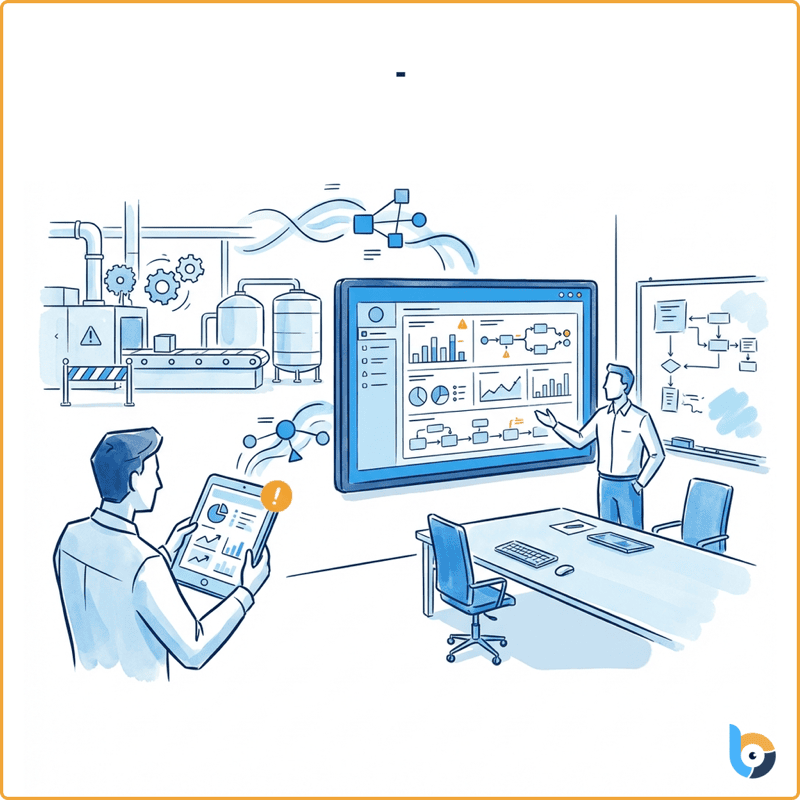
Workplace OHS Hazard Analysis: An Essential Prevention Tool
A workplace Occupational Health and Safety (OHS) hazard analysis by workstation is a fundamental tool for any employer committed to protecting their employees. It involves identifying, assessing and prioritizing occupational risks that workers are exposed to, station by station, in order to implement appropriate prevention measures.
Why Conduct a Workplace OHS Hazard Analysis
A Pillar of Prevention
A workplace OHS hazard analysis enables you to:
- Identify all hazards that workers are exposed to in their daily activities
- Assess the risk level to prioritize prevention actions
- Meet legal requirements for occupational health and safety (Labor Code, ISO 45001 standards)
- Reduce workplace accidents and occupational diseases
- Demonstrate the company’s commitment to employee safety
The Regulatory Framework
Labor legislation imposes a general safety obligation on every employer towards their workers. Key points:
- Who is affected? Any company employing workers
- Who conducts it? The employer, with participation from workers and employee representatives
- What format? Open format (paper, digital), but it must be documented and accessible
- When to update? Regularly and whenever there is a significant change in working conditions
Consequences of Non-Compliance
Failure to conduct a risk analysis exposes the employer to:
- Administrative and financial penalties as provided by the Labor Code
- Civil liability in case of a workplace accident
- Criminal liability in case of endangering the life of others
How to Create Your OHS Hazard Analysis Step by Step
Step 1: Form the Working Group
The hazard analysis should not be conducted by a single person. Involve:
- The HSE manager or the designated prevention officer
- Managers from each department
- Employee representatives
- Field operators (those who know the real risks)
- The occupational health physician (advisory role)
Step 2: Define the Workstations to Analyze
Break your company down into coherent workstations:
- By workstation
- By workshop or zone
- By activity or trade
- By project (for construction site activities)
Example for a food processing plant:
- Raw material receiving
- Cold storage
- Production line 1
- Production line 2
- Packaging area
- Maintenance
- Shipping
- Administrative offices
Step 3: Identify the Hazards
For each workstation, list all hazards:
Physical hazards: Falls from height, slips and trips, crushing, cuts, burns, noise, vibrations, electrocution
Chemical hazards: Chemical products, dust, fumes, vapors, CMR agents (carcinogens, mutagens, reprotoxic substances)
Biological hazards: Infectious agents, stings, bites, Legionnaires’ disease
Ergonomic hazards: Manual handling, awkward postures, repetitive movements, computer workstation strain
Psychosocial hazards: Stress, work overload, violence, harassment, lone working
Organizational hazards: Night shifts, irregular hours, temporary workers, co-activity
Step 4: Assess the Risks
For each identified hazard, evaluate the risk level. The most common method:
Risk = Severity x Likelihood (x Level of Control)
| Severity | Level | Likelihood | Level |
|---|---|---|---|
| Minor (discomfort, inconvenience) | 1 | Very unlikely | 1 |
| Serious (absence < 30 days) | 2 | Unlikely | 2 |
| Severe (absence > 30 days, permanent disability) | 3 | Likely | 3 |
| Very severe (death, permanent disability > 30%) | 4 | Very likely | 4 |
Criticality matrix:
| S1 | S2 | S3 | S4 | |
|---|---|---|---|---|
| L4 | 4 | 8 | 12 | 16 |
| L3 | 3 | 6 | 9 | 12 |
| L2 | 2 | 4 | 6 | 8 |
| L1 | 1 | 2 | 3 | 4 |
- 1-4 (green): Low risk, monitoring
- 5-8 (yellow): Moderate risk, actions to be planned
- 9-12 (orange): High risk, priority actions
- 13-16 (red): Critical risk, immediate actions
Step 5: Define Prevention Actions
For each significant risk, define actions following the general principles of prevention:
- Avoid risks
- Evaluate risks that cannot be avoided
- Combat risks at the source
- Adapt work to the individual
- Take account of the state of the art
- Replace what is dangerous with what is less dangerous or not dangerous
- Plan prevention measures
- Give priority to collective protective measures over individual protective measures
- Provide appropriate instructions to workers
Step 6: Formalize the Document
Your OHS hazard analysis must contain at a minimum:
- Company identification and the workstations analyzed
- List of hazards identified per workstation
- Assessment of each risk (scoring)
- Existing prevention measures
- Planned prevention actions (responsible person, deadline)
- Date of completion and management validation
How to Update Your Hazard Analysis Effectively
Regular updates are often seen as a chore. Here is how to make them efficient:
Organize a Structured Review
- Collect the period’s data: Workplace accidents, near misses, occupational diseases, audit results, complaints
- Convene the working group: Review the situation by workstation
- Identify changes: New equipment, new products, reorganizations, new employees
- Reassess risks: Adjust scores based on developments
- Update the action plan: Close completed actions, add new ones
Integrate Updates into Your Daily Routine
Rather than doing everything once a year:
- Update the analysis after every significant accident or near miss
- Integrate risk reviews into your monthly department meetings
- Use field-level feedback to continuously feed your risk assessment
Why You Should Digitalize Your OHS Hazard Analysis
Limitations of a Paper or Excel-Based Analysis
- Difficulty in collaborative updates
- Risk of version loss
- No traceability of changes
- Complex multi-site consolidation
- Limited access for employees
Benefits of a Digital Analysis
- Real-time updates by field managers
- Complete history of all changes
- Automatic generation of the document from the risk database
- Dashboards for tracking prevention actions
- Easy access for all stakeholders
- Automatic multi-site consolidation for corporate groups
Conclusion
A workplace OHS hazard analysis is not a document to produce for compliance purposes and then file away in a drawer. It is a living tool that, when used properly, saves lives and protects your company.
The key to an effective analysis? Involve workers in its creation, update it regularly, and make it a genuine decision-making tool for your prevention actions.
Betterfly enables you to create, maintain, and manage your OHS hazard analysis with a platform dedicated to risk management. Interactive scoring matrix, integrated action plan, automatic document generation: request a demo to simplify your risk assessment.