
Complete ISO 9001:2015 Guide - What You Need to Know
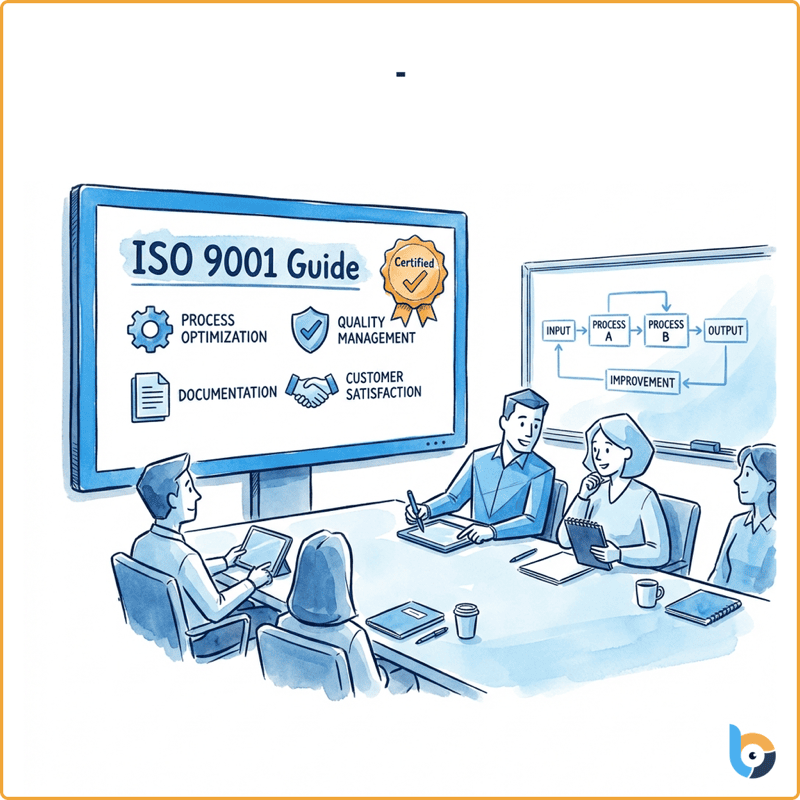
ISO 9001:2015 is the international standard for quality management systems. If you’re reading this article, it’s probably because you’re considering certification or looking to improve your existing system. In either case, you’re in the right place.
Why Is ISO 9001 So Important?
Let’s be honest: ISO 9001 certification isn’t just a diploma to display in the lobby. It’s a genuine transformation tool for your organization.
The tangible benefits:
- Strengthened customer trust: Your clients know you follow an internationally recognized framework
- Optimized processes: The process approach forces you to clarify and improve your working methods
- Reduced errors: Fewer nonconformities = fewer hidden costs
- Competitive advantage: In many industries, certification has become a prerequisite
The 7 Quality Management Principles
ISO 9001:2015 is built on 7 fundamental principles:
1. Customer Focus
Everything starts with the customer. Understanding their needs, exceeding their expectations, measuring their satisfaction. Without satisfied customers, there is no sustainable business.
2. Leadership
Top management must drive the quality initiative. It’s not just the quality manager’s responsibility – it’s everyone’s concern, starting from the top.
3. Engagement of People
Your employees are your greatest asset. Engaged and competent people are the key to a living QMS.
4. Process Approach
Think in terms of flows, inputs, outputs, and interactions. This cross-functional perspective breaks down silos.
5. Continual Improvement
Never settle for the status quo. Constantly strive to do better, even when things are going well.
6. Evidence-Based Decision Making
Base your decisions on data, facts, and indicators. Intuition is fine, but numbers are better.
7. Relationship Management
Suppliers, partners, the community… Your ecosystem matters to your performance.
Structure of the Standard (HLS)
ISO 9001:2015 follows the High-Level Structure (HLS) common to all ISO management system standards:
- Scope
- Normative references
- Terms and definitions
- Context of the organization
- Leadership
- Planning
- Support
- Operation
- Performance evaluation
- Improvement
This structure facilitates integration with other standards such as ISO 14001 or ISO 45001.
Key Requirements to Master
Context of the Organization (Clause 4)
This has been new since the 2015 revision: you must analyze your internal and external environment, identify your interested parties, and understand their expectations. This is the foundation of your QMS.
Our advice: Use a SWOT matrix and a stakeholder mapping exercise. Document them and update them annually.
Risk-Based Thinking (Clause 6)
Gone are traditional preventive actions. In their place is a holistic approach to risks and opportunities. For each process, identify what could go wrong and how to prepare for it.
Our advice: Integrate risk analysis into your process reviews. You don’t need a full FMEA for every topic.
Documented Information (Clause 7.5)
Good news: the standard no longer refers to “mandatory procedures” or a “quality manual.” You are free to document however you see fit, as long as it is controlled and appropriate to your context.
Our advice: Document what is useful, not what is “mandatory.” A document that nobody reads is a useless document.
Mistakes to Avoid
After supporting hundreds of organizations, here are the most common pitfalls:
-
Creating a parallel system: Your QMS must reflect what you actually do, not an ideal world disconnected from reality.
-
Over-documenting: 200 procedures that nobody reads won’t help you on audit day.
-
Neglecting top management involvement: If the CEO isn’t interested, why should anyone else be?
-
Forgetting continual improvement: Certification is not the finish line – it’s the starting point.
-
Copying another company’s system: Every organization is unique. Draw inspiration, but adapt.
How to Prepare for the Audit
The certification audit is not a pass/fail exam. It’s an opportunity to get an external perspective on your system. Here’s how to approach it with confidence:
Before the Audit
- Conduct a thorough internal audit
- Address identified nonconformities
- Prepare your management review
- Ensure indicators are up to date
During the Audit
- Be transparent and honest
- Show what you actually do
- Involve your team members
- Take notes on the auditor’s remarks
After the Audit
- Address nonconformities within the required timeframes
- Communicate results internally
- Celebrate the certification with your teams!
Conclusion
ISO 9001:2015 is not an administrative burden – it’s a tool for progress. Used properly, it enables you to structure your organization, satisfy your customers, and continuously improve.
The key to success? A system tailored to your reality, driven by top management, and lived every day by your teams.
Need help structuring your approach? Betterfly supports you at every stage, from the initial assessment through certification and beyond.