
ISO 45001: How to Structure Your Occupational Health & Safety System
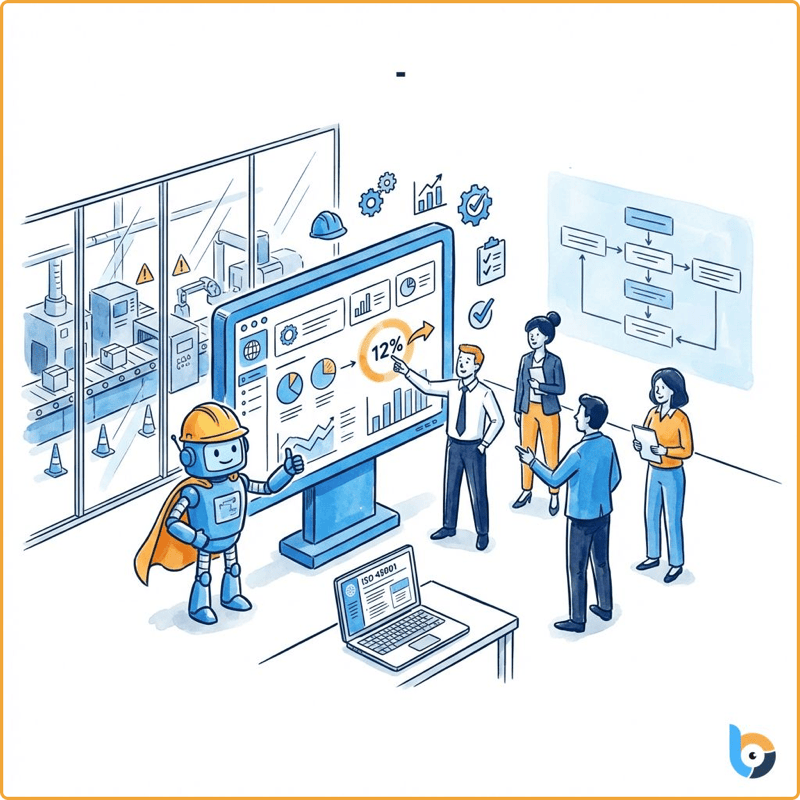
Why ISO 45001 Is Essential
Every year, thousands of workplace accidents and occupational diseases affect businesses. Beyond the human tragedy, the consequences are severe: lost work time, increased insurance premiums, criminal liability, and reputational damage. ISO 45001, published in March 2018, is the first international standard for Occupational Health and Safety (OHS) management systems.
It replaces OHSAS 18001 and introduces a more modern vision, centered on prevention, worker consultation, and integrating OHS into the organization’s strategy.
What Changed from OHSAS 18001
| Aspect | OHSAS 18001 | ISO 45001 |
|---|---|---|
| Structure | Proprietary | HLS (common ISO structure) |
| Approach | Reactive (hazards) | Proactive (risks AND opportunities) |
| Leadership | HSE manager | Top management |
| Workers | Consulted | Actively participate |
| Context | Not required | Mandatory analysis |
| Contractors | Partially covered | Fully integrated |
| Life cycle | Not addressed | Taken into account |
The Pillars of ISO 45001
1. Leadership and Worker Participation
This is the most significant change. Top management can no longer delegate OHS solely to the HSE manager:
- Top management must be accountable for the effectiveness of the OHS system
- Workers must participate in hazard identification, risk assessment, and defining control measures
- Consultation is not optional – it is a normative requirement
An OHS system that truly works is one where every worker feels empowered to report a hazard, without fear of retaliation.
2. Hazard Identification and Risk Assessment
ISO 45001 requires a systematic approach:
Categories of hazards to consider:
- Physical (noise, vibration, extreme temperatures)
- Chemical (hazardous substances, dusts)
- Biological (infectious agents, allergens)
- Ergonomic (postures, manual handling, screen-based work)
- Psychosocial (stress, harassment, workload)
- Organizational (lone working, atypical schedules)
Assessment process:
- Identify work activities and situations
- List associated hazards
- Assess risks (likelihood x severity)
- Define the hierarchy of control measures
- Implement and verify effectiveness
3. The Hierarchy of Controls
The standard mandates a priority order for treating risks:
- Elimination: Remove the hazard at its source
- Substitution: Replace with something less hazardous
- Engineering controls: Isolate people from the hazard (collective protection)
- Administrative controls: Procedures, training, signage
- PPE: Personal Protective Equipment (last resort)
Too many organizations start with PPE. The standard requires you to start from the top.
4. Planning and Management of Change
Every change must be assessed from an OHS perspective:
- New processes or equipment
- Changes in work organization
- New chemical products
- Facility changes
- Engaging new contractors
Implementing Your OHS System: Key Phases
Phase 1: Diagnostic and Commitment
- Conduct a comprehensive OHS baseline assessment
- Analyze regulatory compliance (labor code, classified installations, workplace accident/occupational disease regulations)
- Obtain formal commitment from top management
- Assemble the project team
Phase 2: Analysis and Planning
- Map all positions and activities
- Identify hazards and assess risks
- Draft or update the occupational risk assessment document (DUERP in French regulatory context)
- Define the OHS policy and objectives
- Plan risk reduction actions
Phase 3: System Design
- Define OHS processes (accident management, investigations, authorizations…)
- Establish operational control procedures
- Organize emergency preparedness and response
- Structure OHS regulatory monitoring
- Define performance indicators (leading and lagging)
Phase 4: Deployment
- Train and raise awareness across all personnel
- Implement planned prevention actions
- Launch safety talks and field inspections
- Deploy incident reporting tools
Phase 5: Verification and Certification
- Conduct OHS internal audits
- Perform the management review
- Analyze indicators and trends
- Undergo the certification audit (Stages 1 and 2)
Essential OHS Indicators
Lagging Indicators (Reactive)
- Lost Time Injury Frequency Rate (LTIFR)
- Severity Rate
- Number of lost workdays
- Number of declared occupational diseases
Leading Indicators (Proactive)
- Number of near-misses reported
- Completion rate of field safety inspections
- Percentage of positions with up-to-date risk assessments
- OHS training completion rate (actual vs. planned)
- Number of safety talks conducted
- Average turnaround time for prevention actions
The best OHS systems measure what they prevent, not just what happens.
Field Best Practices
Building a Safety Culture
- Make OHS visible: Posters, signage, dashboards on the shop floor
- Engage managers: They are the essential link between policy and the field
- Value near-miss reporting: Every near-miss reported is a win
- Address behaviors, not just outcomes: Not wearing PPE is a problem, even if nothing happened
- Communicate successes: X days without an accident, successful prevention actions…
Toolbox Talks
A simple yet powerful tool:
- 10-15 minutes before the start of the shift
- A concrete topic related to the day’s activities
- Interactive discussion, not a lecture
- Documented and archived
ISO 45001 and the Occupational Risk Assessment Document (DUERP)
The DUERP (Document Unique d’Evaluation des Risques Professionnels) is a regulatory obligation under French law. ISO 45001 goes further, but the two approaches are complementary:
- The ISO 45001 risk analysis directly feeds the DUERP
- The DUERP becomes a natural deliverable of the OHS system
- The annual DUERP update integrates into the standard’s PDCA cycle
With a tool like Betterfly, the DUERP is automatically generated from your risk analysis, always up to date and accessible to all.
Conclusion
ISO 45001 is much more than a standard: it is a commitment to your employees. It structures your prevention approach, holds top management accountable, and gives workers a voice.
The organizations that succeed in certification are those that do not see it as an HSE project, but as a company-wide initiative. Safety is not a cost – it is an investment in your most valuable asset: the people who make your organization what it is.
Betterfly helps you structure your OHS system with risk management tools, accident and near-miss tracking, and real-time OHS dashboards. Request a demo to discover how to protect your teams more effectively.