
QHSE in the Food Industry: The 5 Must-Know Regulatory Requirements
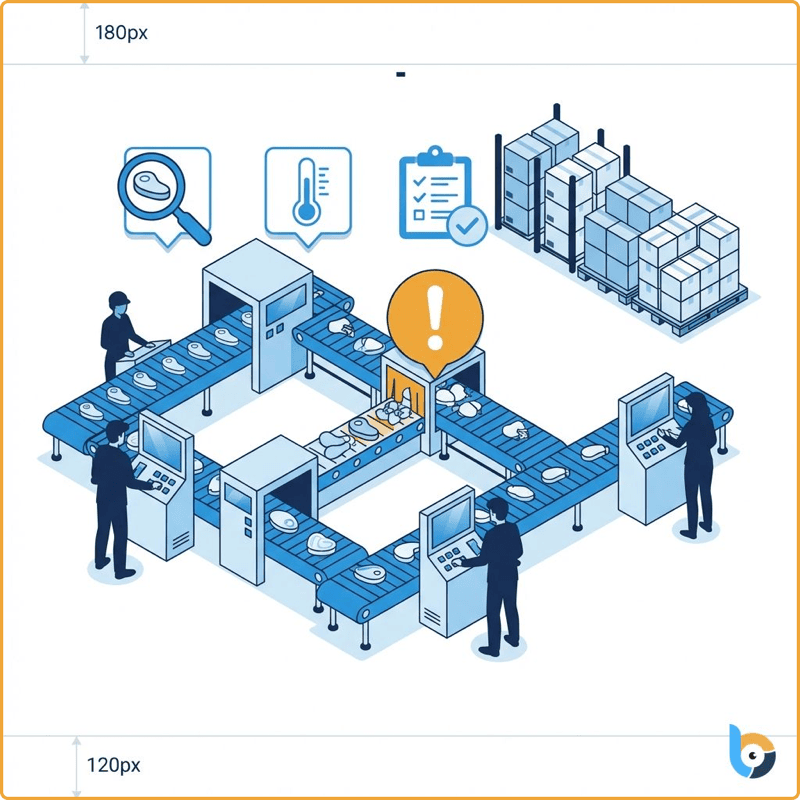
The Food Industry: A Sector Under Close Scrutiny
The food industry is one of the most heavily regulated sectors in the world. And for good reason: food safety is a public health concern that tolerates no approximation. For a QHSE manager in the food industry, the obligations are numerous and the penalties severe.
Here are the 5 regulatory pillars that every professional in the sector must master.
Requirement 1: The HACCP Plan and Food Safety
What the Regulations Say
EU Regulation (EC) No 852/2004 on the hygiene of foodstuffs requires every food business operator to implement a food safety management plan based on HACCP principles.
What You Need to Do
The Food Safety Management Plan (PMS in French: Plan de Maitrise Sanitaire) includes:
-
Prerequisite Programs (PRPs): Basic hygiene good practices
- Cleaning and disinfection schedule
- Pest control program
- Cold chain management
- Personnel hygiene
- Water management
- Waste management
-
The HACCP Study: Hazard analysis specific to your products
- Hazard analysis (biological, chemical, physical)
- Determination of CCPs (Critical Control Points)
- Critical limits, monitoring, corrective actions
- Verification and documentation
-
Traceability: The ability to track every product at every stage
Inspections
Regulatory authorities (in France: the DDPP, veterinary and food safety services) regularly inspect facilities. Penalties range from warnings to administrative closure, including fines of up to 300,000 euros and 2 years of imprisonment for endangering consumer health.
Best Practices
- Review your HACCP plan whenever there is a change in product, process, or supplier
- Regularly train your staff on good hygiene practices
- Conduct internal HACCP audits at least twice a year
- Retain all CCP monitoring records
- Test your recall/withdrawal procedure at least once a year
Requirement 2: Full Traceability
What the Regulations Say
EU Regulation (EC) No 178/2002 (General Food Law) mandates “one step forward, one step back” traceability for all operators in the food chain.
What You Need to Do
Upstream traceability:
- Identification of all raw material and ingredient suppliers
- Recording of received batches (batch number, date of receipt, quantity)
- Certificates of analysis and conformity for raw materials
- Transport conditions upon receipt
Internal traceability:
- Link between raw material batches and finished product batches
- Recording of manufacturing conditions (temperature, duration, parameters)
- Batch identification at every step of the process
Downstream traceability:
- Identification of all customers who received each batch
- Quantities delivered per batch and per customer
- Delivery dates and transport conditions
The Mock Recall Exercise
The regulation does not explicitly require it, but BRC and IFS standards do. It involves simulating a product recall to verify that your traceability system works:
- Select a finished product batch at random
- Within 4 hours, identify all raw materials used AND all customers supplied
- The target: 100% traceability in under 4 hours
Requirement 3: Allergen Management
What the Regulations Say
EU Regulation (EU) No 1169/2011 (INCO) requires the declaration of 14 major allergens on the labeling of all foodstuffs.
The 14 Allergens to Declare
- Cereals containing gluten
- Crustaceans
- Eggs
- Fish
- Peanuts
- Soybeans
- Milk (lactose)
- Tree nuts
- Celery
- Mustard
- Sesame seeds
- Sulphur dioxide and sulphites
- Lupin
- Molluscs
What You Need to Do
- Allergen mapping: For each product, identify the allergens present in the ingredients
- Cross-contamination risk analysis: Shared lines, common storage, cleaning between production runs
- Operational control: Flow separation, production scheduling, validated cleaning
- Compliant labeling: Clear mention of allergens (in bold in the ingredient list)
- Staff training: Awareness of allergen-related risks
Common Mistakes
- Forgetting hidden allergens in additives and processing aids
- Underestimating cross-contamination risks through shared equipment
- Systematically using “may contain…” instead of genuinely controlling the risk
- Not updating the allergen mapping after a supplier change
Requirement 4: Workplace Safety Specific to the Food Industry
Sector-Specific Risks
The food industry combines a number of specific occupational hazards:
Cold-related risks:
- Working in cold rooms (0 to -30 C)
- Musculoskeletal disorders amplified by cold
- Slip hazards on wet or icy floors
Chemical risks:
- Concentrated cleaning and disinfection products
- Ammonia (refrigeration systems)
- CO2 (fermentation, modified atmosphere packaging)
Biological risks:
- Exposure to allergens
- Zoonoses (in the meat supply chain)
- Legionellosis (cooling towers)
Ergonomic risks:
- Repetitive movements on packaging lines
- Manual handling (raw materials, finished products)
- Awkward postures (working at height on tanks)
Machine-related risks:
- High-speed production lines
- Cutting, grinding, mixing equipment
- Maintenance interventions on running machinery
What You Need to Do
- A specific risk assessment document (in France: Document Unique / DUERP) incorporating all of the above risks
- A musculoskeletal disorder prevention plan (the leading cause of occupational illness in the sector)
- Specific certifications (forklift operation, electrical work, working at height, confined space entry)
- Enhanced medical monitoring for positions exposed to cold, noise, and chemical agents
Requirement 5: Retail Standards
Why Are They Essential?
If you supply large-scale retailers, BRC (British Retail Consortium) and IFS (International Featured Standards) are de facto mandatory. They are not regulations, but contractual requirements imposed by distributors.
BRC Global Standard for Food Safety (Version 9)
Key points:
- Certification grades: AA, A, B, C, D (below C, no certification)
- Annual audit (or every 6 months for the lowest grades)
- Strengthened requirements for food safety culture
- Food fraud and food defense are mandatory
- GFSI certification (international recognition)
IFS Food (Version 8)
Key points:
- Percentage-based scoring (minimum 75% for basic certification)
- Higher level starting at 95%
- 10 KO (Knock Out) criteria: non-conformities that automatically result in audit failure
- Focus on management responsibility and resource management
- GFSI-recognized certification
The 10 IFS Food KO Criteria
These points are eliminatory: a single major non-conformity on any of them means audit failure:
- Management commitment
- CCP monitoring system
- Personnel hygiene
- Raw material specifications
- Finished product specifications
- Foreign body management
- Traceability
- Internal audits
- Withdrawal/recall procedure
- Corrective actions
How to Structure Your Food Industry QHSE System
The Integrated Approach
Do not manage food safety, occupational health and safety, and environment in separate systems. Build an integrated system:
- A single process map that incorporates HACCP, OHS, and environmental requirements
- A common document management system with procedures covering all aspects
- An integrated audit program that checks all dimensions
- A QHSE dashboard that consolidates indicators across all 3 domains
- A single management review that addresses all topics
Key Sector Indicators
- Number of product recalls/withdrawals
- Microbiological analysis results (% compliant)
- Customer complaints related to food safety
- BRC/IFS score
- Internal HACCP audit completion rate
- Mock recall results (response time)
- Lost-time injury frequency rate
- Reported musculoskeletal disorders
Conclusion
The food industry is a sector where QHSE is not an option but a condition for survival. The obligations are numerous, but they share a common goal: producing safe food, under secure working conditions, while respecting the environment.
The key to success? An integrated system, trained teams, and tools that simplify daily operations rather than adding complexity.
Betterfly supports numerous food industry companies in managing their QHSE system, from HACCP compliance to BRC and IFS standard monitoring. Request a demo to see how our platform adapts to the specificities of your sector.